
Digital marketing is one of the most beginner-friendly careers in India in 2026. You do not need a specific degree, an expensive course, or a metro city address to start. What you do need is a clear order of skills, one or two free certifications, and a small portfolio of real practice projects.
This guide gives you exactly that. You will learn the order in which to learn digital marketing skills, a month-by-month plan from zero to job-ready, the certifications actually worth your time, how to build proof of work without a job, and an honest look at salaries and timelines. Follow it with about 1-2 focused hours a day, and most sincere beginners reach a job-ready level in about six months.
A quick note on honesty: no roadmap can promise you a job or a salary. This one promises something better: a clear, practical path where every step is something you can actually do.
Is Digital Marketing a Good Career in India in 2026?
Short answer: yes, with conditions. Businesses of every size now need people who can bring customers online, and that demand has stayed steady for years. Digital marketing rewards skill over credentials, which is rare and valuable for beginners.
But be honest with yourself about the other side. Entry-level competition is real. Thousands of people finish the same free courses every month. What separates the ones who get hired is proof of work: a small blog with real traffic, a practice ad campaign, a portfolio page. Degrees and certificates open almost no doors on their own; practice projects open most of them.
This career suits you if you are curious about how the internet actually works, you are comfortable learning tools on your own, and you are patient enough to build results over months, not days. It suits you less if you want guaranteed outcomes, because there are none in any honest version of this story.
What Digital Marketing Jobs Actually Look Like
Before the roadmap, know the destination. These are the real entry and mid-level roles you will see on job portals in India:
| Role | What the work looks like day to day |
|---|---|
| SEO Executive | Keyword research, writing and optimising pages, fixing on-page issues, tracking rankings in Search Console |
| Social Media Executive | Planning content calendars, designing or briefing creatives, scheduling posts, replying to comments, reading insights |
| Performance Marketer | Running Google and Meta ad campaigns, setting budgets, testing creatives, reporting on cost per lead or sale |
| Content Marketer | Writing blogs and landing pages, planning content around keywords, working with SEO and social teams |
| Email Marketer | Building email lists, writing campaigns and automations, testing subject lines, tracking open and click rates |
| Digital Marketing Manager | Planning strategy across channels, managing budgets and junior team members, reporting results to leadership |
Most beginners start in one of the first four rows and grow toward specialist or manager roles in 2-4 years. Notice that every role needs the same foundation: understanding how people find things online and how to read basic numbers.
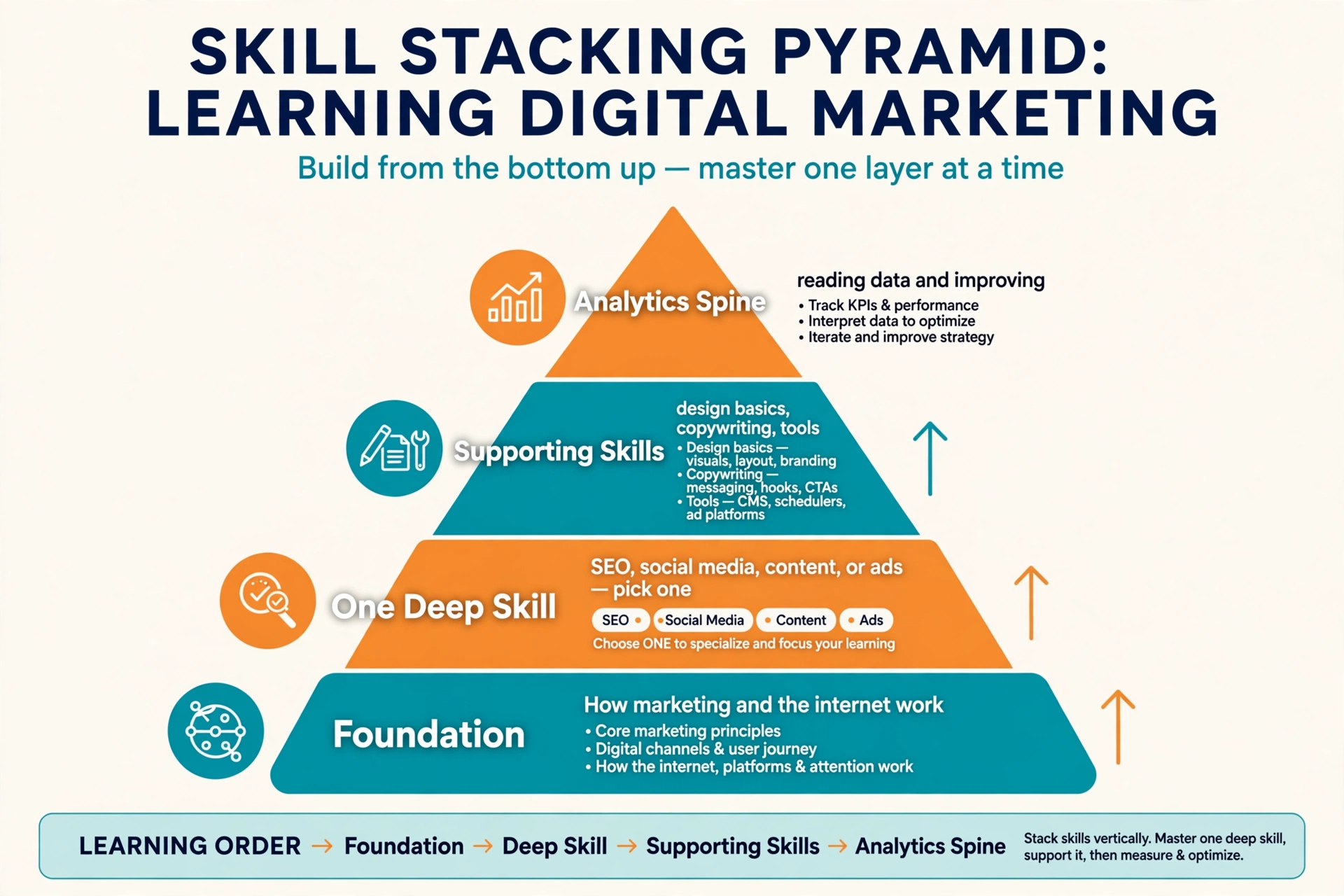
The Skill-Stacking Order (Learn in This Sequence)
The biggest beginner mistake is learning everything at once: a week of SEO videos, then ads, then Canva, then email. Nothing sticks. Skills compound only when they stack in the right order.
Layer 1: Foundation. How marketing and the internet actually work. Customer journeys, how search engines and social platforms decide what to show, what a conversion is. One week of honest reading here saves months of confusion later.
Layer 2: One deep skill. Pick exactly one: SEO, social media, content, or paid ads. Go deep for two months. One strong skill gets you an entry-level job; four shallow skills get you none.
Layer 3: Supporting skills. Design basics (Canva is enough to start), copywriting, and the tools around your deep skill. These multiply the value of your one deep skill. For a task-by-task map of beginner-friendly AI tools with INR prices, see our AI tools for digital marketing guide.
Layer 4: Analytics spine. Reading data and improving. Google Analytics, Search Console, ad reports. This is what separates a doer from a performer, and it grows with every layer below it.
Which Deep Skill Should You Pick?
Layer 2 asks you to choose one deep skill. Here is a simple way to decide:
| If this sounds like you | Consider starting with |
|---|---|
| You like writing and research, and you are patient | SEO + content |
| You live on Instagram and understand trends fast | Social media marketing |
| You like numbers, testing, and fast feedback | Paid ads (Google/Meta) |
| You enjoy explaining things clearly | Content marketing / YouTube |
There is no wrong answer. Pick the one you will actually practise daily for two months. You can add a second skill later; the foundation and analytics layers transfer across all of them.
What Each Deep Skill Actually Involves
To pick well, know what the daily learning looks like for each option:
SEO. Keyword research, on-page optimisation, writing content that answers search intent, basic technical checks, and link building. Slow feedback (results take weeks), but the skill compounds and every business with a website needs it.
Social media marketing. Content calendars, short-form video and carousel formats, community management, and reading platform insights. Fast feedback and the most natural fit if you already spend hours on these apps, but algorithms change often, so adaptability matters.
Paid ads. Campaign setup on Google and Meta, audience targeting, budget management, ad copy and creative testing. The fastest feedback loop of all four and strong demand from agencies and D2C brands, but you need a small practice budget (even 500-1000 rupees teaches you the mechanics).
Content marketing. Writing blogs, guides, and landing pages; planning content around keywords; basic distribution. The most transferable skill: good content ability improves your SEO, social, and email work too.
Whichever you pick, the supporting layers (design basics, copywriting, analytics) look the same, which is why the stacking order works.
The 6-Month Roadmap: Zero Se Job-Ready
Here is the month-by-month plan. It assumes 1-2 focused hours per day and mostly free resources.
| Month | Focus | What you actually do |
|---|---|---|
| Month 1 | Foundation + pick your deep skill | Finish a free fundamentals course (Google Digital Garage or HubSpot Academy). Read how search, social, and ads work. Choose ONE deep skill by month end. |
| Month 2 | Go deep + first certification | Study your deep skill daily. Complete the matching free certification (e.g., Google Skillshop for ads, HubSpot for content/inbound). Start a practice project: a blog, a niche Instagram page, or a test ad account. |
| Month 3 | Practice + supporting skills | Publish real work weekly on your practice project. Learn Canva basics and simple copywriting. Write down everything you try and what happened. |
| Month 4 | Analytics + portfolio building | Connect Google Analytics and Search Console to your project. Build a simple portfolio page (Google Sites or WordPress) with screenshots and honest notes about results. |
| Month 5 | Depth + visibility | Take one small project for a local business, friend, or internship. Post your learnings on LinkedIn weekly. Start applying to internships. |
| Month 6 | Apply with proof | Apply to entry-level roles and internships with your portfolio, not just your resume. Keep practising; interviews will test what you can do, not what you watched. |
One caution: timelines vary. Some people take four months, some take nine. The roadmap works if you do the practice; the calendar is a guide, not a promise.
Free Learning Resources (Honest Notes)
You can learn the full foundation without paying anything. These are the resources worth your time:
- Google Skillshop (free): Google Ads and Google Analytics certifications. These are the most recognised free credentials in the industry, and the courses themselves are genuinely well made.
- HubSpot Academy (free): Inbound Marketing and Content Marketing certifications. Excellent for the foundation layer and for content-focused beginners.
- Meta Blueprint (courses free, some exams paid): The official way to learn Facebook and Instagram advertising properly.
- Google Digital Garage: A gentle starting point for absolute beginners who need the big picture first.
- YouTube: Plenty of good tutorials, but be selective. Prefer creators who show their screen and explain reasoning over those who only show results.
Paid courses make sense later, when you know exactly which skill you want to deepen and you want structure plus feedback. Buying a course before you have practised anything is one of the most common beginner mistakes.
Certifications: Which Ones Actually Matter
Certificates do not get you hired. Portfolios do. That said, two or three relevant certifications on your LinkedIn show you are serious and they teach you real platform knowledge. Prioritise in this order:
- Google Ads certification (free, via Google Skillshop) if ads is your deep skill
- Google Analytics certification (free, via Google Skillshop) for the analytics spine
- HubSpot Inbound or Content Marketing (free) for content and SEO paths
- Meta certified exams (paid) only when you are serious about a paid-social career path
Skip any certification that mainly teaches you how to pass its own exam. If you can run a real campaign and read the report, you already have the part employers care about.
Build Proof of Work (Your Portfolio)
Hiring managers spend very little time on resumes without proof. Your portfolio does not need to be fancy. A simple page with honest documentation beats a polished page with vague claims. Include:
- Links to your practice blog or pages, with what you tried and what happened
- Screenshots of Search Console or Analytics with your own commentary (not fake dashboards, real ones)
- One or two sample campaigns or content pieces with your reasoning explained
- The tools you have used, listed honestly
- A short note on what you are learning next
If you start your practice blog with WordPress, this guide on why WordPress is a strong skill to learn in 2026 explains the setup thinking. For a practice project, try building a simple landing page too; this walkthrough of building high-converting landing pages with Elementor shows what good structure looks like.
Never fake results. One honest screenshot of a small real improvement is worth more than any invented traffic graph, and experienced interviewers can tell the difference.
Job-Ready Checklist
Do not start applying until you can tick most of these:
- [ ] You can explain what your deep skill does for a business in two sentences
- [ ] You hold at least one relevant free certification
- [ ] You have a practice project with at least 8-12 weeks of real activity
- [ ] Your portfolio page exists with real links, screenshots, and honest notes
- [ ] You can read a basic Analytics or ad report and say what to do next
- [ ] Your LinkedIn profile lists your skill, certification, and portfolio link
- [ ] You have applied to at least 10 internships or entry-level roles with a custom note each
Salary Reality Check (Honest Ranges, Not Promises)
Let us be direct. Job portals in India commonly advertise entry-level digital marketing roles in roughly the 2.5 to 4.5 lakh per annum range, with performance marketing roles sometimes advertised higher. With 2-3 years of proven results, advertised ranges commonly move higher. Freelancers and remote workers can earn above these ranges, and can also earn far less while starting out.
Treat every number in this section as a rough orientation, not a promise. Your actual outcome depends on your city, your skill depth, your portfolio, and plain luck in timing. Anyone who guarantees you a specific salary before seeing your work is selling you something, and you should read our guide on verifying a course before you pay for it.
Common Mistakes Beginners Make
- Learning everything at once. Depth in one skill beats surface knowledge in five.
- Collecting certificates without practising. Ten certificates and zero projects lose to one certificate and three projects.
- Waiting to feel ready. You will never feel ready. Start the practice project in month two, not month six.
- Ignoring analytics. If you cannot read numbers, you cannot improve, and you cannot prove value.
- Paying for a course too early. Practise free first; pay later for structure and feedback when you know what you need.
- Faking portfolio results. Interviewers check. Honesty about small real results builds more trust than big invented ones.
FAQs
Do I need a degree in marketing to start? No. Employers in this field hire for demonstrated skill. A degree helps in some corporate roles, but a strong portfolio outweighs it for most entry-level positions.
Hindi medium se padh sakte hain kya? Haan. Fundamentals aap Hindi me samajh sakte hain, aur kaafi achhe Hindi creators hain. Lekin tools, certifications, aur job interviews mostly English me hote hain, isliye basic professional English par bhi kaam karte rahiye.
How many hours a day do I need? About 1-2 focused hours daily is enough if you spend most of that time practising rather than watching tutorials. Consistency beats intensity.
Should I do an internship or a job first? If you have no proof of work yet, a 2-3 month internship is often the fastest bridge. Treat it as paid practice: the portfolio pieces you build there matter more than the stipend.
Is freelancing better than a job for beginners? For most beginners, a job or internship first is the steadier path because you learn systems, feedback, and teamwork. Freelancing rewards the same skills but adds client-finding on top, which is a second full-time skill by itself.
A Structured Way Forward
If you have read this far, you already have the map. The hard part is walking it alone: staying consistent for six months, knowing what to practise each week, and getting feedback when you are stuck. Padhaku’s Skill Seeker program is built for exactly this stage: structured, practical digital marketing learning for beginners in India, with an emphasis on doing real work rather than collecting certificates. Explore the Skill Seeker program and see if the structure fits how you learn. You can also browse free resources to start practising today.
About Padhaku
Padhaku is an India-focused digital skills learning platform founded by Anubhav Shukla. It focuses on making practical digital education more accessible to learners.
1 Comment.