A new client messages you on Upwork or WhatsApp. They like your profile, and before they hire you, they want one small thing: a free test task. A sample article. A logo draft. A few lines of code. “Just to check your quality,” they say. “If it is good, the full project is yours.”
It sounds reasonable. It is also the most common way beginners in India end up working for free. The test is often the real work, the client disappears after delivery, and there is no contract, no milestone and no payment to chase.
The short answer: a short skill check is normal, but a free test task that produces usable work is not. If the task takes more than about 30 minutes, or if the client can use what you make, it is paid work, and it should be paid through a funded milestone or an active contract. Offer a portfolio sample or a small paid test instead, and walk away politely if the client insists on free deliverables.
Padhaku teaches freelancing as a practical skill, and protecting your time is part of that skill. This article explains how to tell a fair test from a free-work trap, what the platforms actually say, and the exact words you can use to decline without burning a bridge.
What is a free test task, exactly?
A test task is a piece of work a client asks you to complete before hiring you, so they can judge your skill. It becomes a “free test task” when no payment, contract or milestone exists for it.
Not every test is a scam. There are three kinds, and only one of them is a trap:
- A short skill check. A 20 to 30 minute exercise that shows how you think, such as a short paragraph, a small design variation, or a few lines of code. It is not usable as a finished deliverable.
- A portfolio review. The client looks at work you have already done. This costs you nothing and is the safest option for both sides.
- A paid trial. A small first milestone with real payment, such as one article, one screen, or one hour of work. This is how professional clients test new freelancers.
The trap version is different: the “test” is a full article, a complete logo set, a finished landing page, or a real client project that the person asking can use or sell. When the work is usable and unpaid, it is not a test. It is free labour, and the person asking knows the difference.
Why this trap works so well on beginners in India
Beginners are the target because the pressure is real. You need a first client, you have no reviews yet, and every message feels like your one chance. The client knows this, and the request is usually framed to use it.
Common lines you will hear: “We test everyone like this.” “Our budget starts after the test.” “Do this one free and we will give you regular work.” None of these is a promise you can enforce. Without a contract or a funded milestone, “regular work” is a sentence in a chat, not an agreement.
There is also a genuine confusion behind the trap. Some clients have honestly never hired a freelancer before and copy a hiring habit from full-time jobs, where a short interview task is normal. That is why the right response is not anger. It is a clear, polite boundary, offered with an alternative. Good clients accept the alternative. Clients who only wanted free work do not, and their refusal tells you everything you need to know.
If you are still working towards your first client, the first-client playbook on Padhaku explains the full process, from profile to proposal to paid work, so a single test task never becomes your whole strategy.
Fair test or free-work trap? Use this decision table
When a test request arrives, run it through this table before you reply. One “trap” answer does not always mean a scam, but two or three together mean you should not do the work for free.
| What to check | Fair test | Free-work trap |
|---|---|---|
| Size of the task | Short, under 30 minutes, clearly a sample | A full deliverable: a complete article, logo set, video edit or web page |
| Can the client use it? | No, it is a practice piece or an old sample brief | Yes, it is their live project, brand or customer-facing content |
| Payment | Paid as a small milestone, or so short that payment is impractical | Unpaid, with payment “after selection” or “after the trial” |
| Contract or milestone | A contract exists, or the test is genuinely trivial | No contract, no funded milestone, no verified payment method |
| What happens next | Clear: who reviews it, by when, and what the paid project pays | Vague: “we will see”, “if we like it”, no timeline, no rate |
| How many rounds | One short round | Multiple rounds, each bigger than the last |
| Files requested | A screenshot, a PDF preview, or a view-only link | Source files, editable files, or full-resolution originals before payment |
The rule behind the table is simple: if it takes more than 30 minutes, or the client can use it, it is paid work. A short, standardised sample that nobody can publish is the only kind of free test worth considering.
7 red flags in a test task request
Watch for these signs. Any one of them is a reason to slow down and ask questions. Several together mean you should decline the free version and offer a paid alternative instead.
1. The test is the full deliverable
A “sample” of 1,500 words, a complete homepage design, or a finished video edit is not a sample. It is the project, relabelled. Real tests are small by design, because their job is to show skill, not to produce output.
2. No contract, no funded milestone, no verified payment method
On Upwork, fixed-price work is protected only when the milestone is funded in escrow, and hourly work is protected only when the contract is active and time is tracked. A client who wants work before any of that exists is asking you to give up your only protection first.
3. They push you off the platform before any contract
“Message our HR on Telegram” or “let us talk on WhatsApp” before a contract exists is a red flag on its own. Off-platform chat removes the record that protects you, and it is against most marketplace rules before a contract begins. Our guide to fake Upwork job posts covers this pattern in detail.
4. They are vague about what happens after the test
A genuine client can tell you the rate, the scope of the real project, and when they will decide. If the answers are “we will discuss later” and “it depends on quality”, there is no real project waiting. There is only the free test.
5. Multiple rounds of unpaid tests
One short test can be reasonable. A second test, then a third, each more detailed than the last, is a process designed to extract work. Each round should make the decision clearer, not the workload bigger.
6. Urgency is used to skip the safeguards
“Start now, we will sort the contract tomorrow” is how protection gets skipped. A real deadline applies to the project, not to your decision. A client who cannot wait one day for a funded milestone is telling you how the rest of the project will go.
7. They want source files before payment
Editable files, design source files, or full-resolution originals are the final product. Sharing them before payment hands over everything, including your ability to negotiate. Previews and watermarked drafts exist for exactly this reason.
What the platforms actually say
This is not just etiquette. On Upwork, the platform most Indian beginners use, free work requests are against the rules. Upwork’s own help page on recognising scams states that offers requesting free work upfront or as part of the project violate Upwork’s policies and could be a scam attempt. Its real-life example is exactly this situation: a freelancer is offered a high hourly rate but must first complete a significant amount of free work as a “test”. Upwork calls that a classic red flag and advises the freelancer to report it to Upwork’s support team.
The same help page explains the protection that replaces free tests: for hourly contracts, use the desktop app to track time and stay within the weekly limit; for fixed-price contracts, do not start work until the agreed milestones are fully funded. That is the system working as designed, and a client who asks you to work outside it is asking you to work without a safety net.
Other marketplaces have similar rules, and the details differ by platform, so check the help pages of the platform you use before you accept any test arrangement. The principle is the same everywhere: real clients pay for real work, and the platform’s payment system is what makes that enforceable.
Free tests are not the only trap aimed at new freelancers. Our guide to fake clients and their red flags covers the wider patterns, and our article on advance payment fraud explains the opposite trap, where the “client” asks you to pay before work starts.
The paid-test rule: three replies that protect you
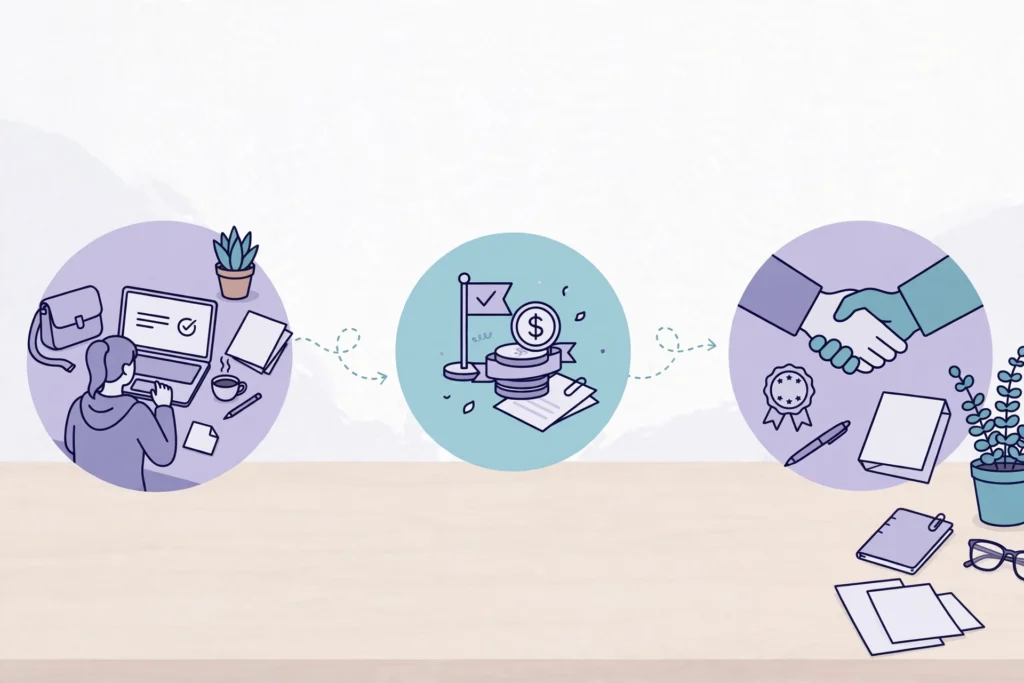
You do not need to argue with a client about free tests. You need three ready replies, and you need to use the right one for the situation.
Option 1: offer a portfolio sample. If you have relevant past work, send that instead of doing new work. “Here are two samples in this exact style. If you need something made for your brand specifically, I can do a small paid test.”
Option 2: propose a small paid test milestone. This is the best option when the client is genuine. “I am happy to do a test. Please create a small funded milestone for it, so we are both protected. A short test of [one article / one screen / one hour] at my usual rate works for me.”
Option 3: decline politely and move on. If the client insists on a full free deliverable, decline in one message and stop negotiating. Your time is better spent on the next proposal than on a test that was never going to pay.
Scripts you can copy: ask, offer, or decline politely
These are templates to adapt to your own words and rates, not legal advice. Replace the bracketed parts with your details, and keep the tone calm and professional.
1. Asking whether the test is paid
“Thanks for considering me. Before I start, could you confirm whether the test task is paid? I am happy to complete a short test, and my rate for test work is [your rate]. If it is unpaid, I can share portfolio samples in this style instead.”
2. Offering a portfolio sample instead of new free work
“I would rather show you finished work than make something new for free, so you can judge the real quality. Here are [two links or attachments] in a similar style. If you would like a sample made for your brand, I can do that as a small paid milestone.”
3. Proposing a small paid milestone
“I am happy to do a test task. Could you please create and fund a short milestone for it on [Upwork / the platform]? That way we are both protected, and if the test goes well, we can continue with the full project on the same contract.”
4. Declining a free full deliverable politely
“Thanks for the opportunity. I do not do full deliverables as unpaid tests, because that is billable work. I would be glad to start with a small paid milestone, or to share samples so you can judge my work. If that does not fit your process, I understand, and I wish you well with the project.”
Notice what none of these scripts do: they never accuse the client of running a scam. A warning sign is not proof of fraud, and many clients asking for free tests are simply following a bad hiring habit. The scripts give them a professional way to do it properly. Their reply tells you which kind of client they are.
A worked example: what one free test really costs
This is a hypothetical example only, to show how the decision works. The person, the numbers and the client are made up, and actual results will differ.
Meet Aarav, a beginner graphic designer from Indore. He has done three small paid projects and is looking for his first regular client. A client messages him on Upwork with a “quick test”: design a complete homepage banner set for their store, three sizes, before any contract. The client says the full project is a month of design work, but the rate will be “discussed after the test”.
Aarav checks the table. The task is a full deliverable the client can use immediately. There is no contract, no funded milestone, and no rate. The task would take him about four hours. At his usual rate of Rs. 800 per hour (his own rate for this example), that is Rs. 3,200 of unpaid work, for a project that may not exist.
He replies with script 3, offering a small paid milestone for one banner size at Rs. 800. The client stops replying. Aarav loses nothing but a message, and spends the four hours on proposals instead. Two days later, another client funds a small milestone for a single banner, reviews it, and hires him for the full project on a proper contract.
The lesson is not that every free test ends badly. It is that a free test has a real price, measured in your hours, and you should decide that price deliberately instead of giving it away by default.
Protect your work if you agree to a short test
Sometimes a very short test is worth doing, for example a 20 minute exercise for a client with a strong, verified history. Even then, protect the work:
- Share previews, not source files. Send a watermarked image, a PDF, or a view-only document link. Keep editable and full-resolution files until payment is agreed.
- Keep everything on the platform. Messages, files and agreements on Upwork or your marketplace create a record. A chat that moves to Telegram before a contract is a record you cannot use.
- Keep your own copies and dates. Save the brief, your sent files, and the message history. If the client later uses your test without paying, that record is the basis of any report you file.
- Set a limit before you start. Decide in advance how much time the test gets, and stop when it is done. A test that grows after you start is no longer a test.
If you already did free work and got ghosted
If this has already happened to you, do not blame yourself. The trap is designed to work on people who are trying to build something. Here is what to do now:
- Stop and preserve the evidence. Do not send more files. Save screenshots of the job post, the chat, and the files you sent, with dates.
- Report it on the platform. On Upwork, use the report and flag tools and then block the user. Free work requests can be reported, and the report helps the next freelancer too.
- Do not chase the client off-platform. Moving to WhatsApp or Telegram to argue rarely recovers anything and can expose you to further pressure.
- For financial fraud, use the official channels. If money was taken from you, report it on the National Cybercrime Reporting Portal at cybercrime.gov.in or call the helpline 1930 for urgent financial fraud. Be aware that unpaid work alone is usually not recoverable as money, and a report is mainly a record that protects others.
- Turn it into a rule. Write down the red flags you missed and the reply you will use next time. A written rule is much easier to follow under pressure than a vague intention.
Checklist: before you say yes to any test
- Is it under 30 minutes, or is it a paid milestone?
- Can the client use what I make, or is it only a sample?
- Is there a contract, or a funded milestone, before I start?
- Has the client told me the rate, the scope, and the decision date for the real project?
- Am I sharing a preview, not source files?
- Is all communication staying on the platform?
- If I say no to the free version, have I offered a paid alternative?
If any answer is no, fix that point before you start, or decline the free version. A client who respects your work will respect this checklist.
Frequently asked questions
Is it ever okay to do a free test?
Yes, in a narrow case: a short, standardised exercise under 30 minutes that shows your skill but cannot be used as a finished deliverable, for a client with a verified history. Even then, a portfolio sample is usually a better option, because it costs you nothing new.
What if I have no portfolio and no clients yet?
Build two or three sample projects of your own, in the style of the work you want. A self-made sample proves your skill without giving a client free labour, and you can reuse it for every proposal. Our beginner freelancing guide explains how to start without a client history.
Can I report a client who asks for free work?
On Upwork, yes: use the report tools on the job or message, and Upwork’s help page specifically lists free work requests as reportable. Off-platform, there is no report button, so the practical answer is to decline, keep your evidence, and warn other freelancers in your communities about the pattern, without naming a person or business a scam unless you have strong evidence.
Will saying no cost me clients?
It will cost you the clients who only wanted free work. Those are not clients; they are a cost. Clients who value your work accept a paid test or a portfolio review, and they are the ones worth your time.
What to learn next
A test task is often your first interaction with a client, so it sets the tone for everything after. Get this decision right and the rest of freelancing gets easier: funded milestones, clear scope, and payment on time. If you want a structured path from your first proposal to your first paid project, the first-client playbook lays it out step by step, and the Income Builder programme teaches the implementation in depth.
About Padhaku
Padhaku is an India-focused digital skills learning platform founded by Anubhav Shukla. It focuses on making practical digital education more accessible to learners. The platform covers freelancing, digital marketing, WordPress, SEO, and related skills, with an emphasis on honest, realistic guidance for Indian beginners.
Sources and further reading
- Upwork Help: Recognise red flags and avoid scams (checked 2026-11-07) – free work requests violate Upwork’s policies; payment protection rules for hourly and fixed-price contracts.
- Karbon Card: Platform Scams, 20 Upwork Traps Indian Freelancers Must Avoid (checked 2026-11-07) – free trial tasks as full deliverables, funded escrow, India reporting channels cybercrime.gov.in and helpline 1930.
2 Comments.