

A new client says yes. You celebrate for five minutes. Then the messages start. “Can you also add a Hindi version?” “My partner wants a different colour, can you redo it?” “We will pay next month, just finish it first.” Two weeks later you have done three times the agreed work, you have not been paid, and the client has stopped replying. Nothing about the work itself was hard. What was missing was onboarding: the short, boring process between “yes” and “start” that turns a verbal agreement into a project you can actually manage.
The short answer: before you start work for a new freelance client in India, get the scope in writing, agree on payment terms and milestones, collect the assets and access you need, hold a short kickoff call, and confirm who approves the work. Do this in the first 48 hours, and do not start production work until the advance has cleared and the scope is confirmed in writing. The 15-point checklist below covers every step.
Padhaku teaches practical digital skills for Indian learners, and freelancing is one of the most common first steps. If you are still looking for your first client, start with the first-client playbook for Indian freelancers, which covers finding and winning the work. This article covers the next step: what to do in the days after a client says yes, so the project starts clean and stays clean.
What client onboarding actually is
Onboarding is the structured handoff from “we just signed” to “the project is running smoothly”. It is not a sales call and it is not the work itself. It is the set of small administrative steps that happen in between: confirming the agreement, collecting information and files, setting communication rules, and agreeing on how the work will be reviewed and paid for. For most freelance projects it takes five to ten business days from the first yes to a properly running project, with the most important parts finished in the first 48 hours.
Think of it as the difference between building a house with a drawing and building one from a phone conversation. The drawing takes an hour to make and saves weeks of argument. Onboarding is that drawing. A client who refuses it is telling you something useful before you have invested any real work.
Onboarding also protects the client. A new client does not know how you work, when to expect updates, or what you need from them. A clear welcome message, a simple timeline, and one named point of contact make them feel they hired a professional, not a stranger from the internet. That feeling is what gets you the second project and the referral.
Why first projects go wrong without onboarding
Most freelance disputes in India follow the same pattern. The freelancer and the client agree on a price over a call or a WhatsApp chat. Nothing is written down. The freelancer starts work immediately, because starting feels like progress. Then the client asks for extras that were never discussed, feedback arrives late or from three different people, and payment waits until “everything is final”, which never quite happens.
Four gaps cause most of this. First, there is no written scope, so “a logo” can mean one version to you and five versions plus a visiting card to the client. Second, there is no payment schedule, so the client treats payment as the last step and you treat it as overdue from week one. Third, nobody agrees who approves the work, so feedback comes from the client’s cousin, their business partner, and their neighbour, and none of it agrees. Fourth, the freelancer starts before collecting the assets, so the project stalls for a week waiting for a logo file or a login, and the delay gets blamed on the freelancer.
Every one of these gaps is fixed by a step that takes minutes. The checklist below is ordered so that the steps which protect your payment come first and the steps which protect your time come second.
The 15-point freelance client onboarding checklist
Use this checklist for every new client, even a small one. Small clients are the most likely to expand the scope casually, precisely because the project feels too small for paperwork. Copy it into a document or a notes app and tick each item off for every project.
Phase 1: Confirm the agreement (before you start)
1. Confirm the project in writing. Send a short message or email that states the service, the agreed price, and the start date. A verbal yes is good news. A written confirmation is the start of a project. Keep it warm and short: what you will do, for how much, and when it starts.
2. Get a signed agreement or a written scope. A one or two-page agreement is enough for most projects. It should state the deliverables, the price, the payment schedule, the number of revisions, the timeline, and what happens if either side wants to stop. If the client will not sign anything, at minimum get the scope, fee, advance and delivery date accepted in writing by email. For larger or complex contracts, a local lawyer’s review is worth the fee. This is practical guidance, not legal advice.
3. Name the decision-maker. Ask, in writing, who gives final approval on the work. The wrong assumption here is the single biggest source of revision spirals later, when three people give three different opinions and nobody can sign off. One named approver, one feedback channel.
Phase 2: Sort out the money
4. Send the advance invoice with the agreement. Never start work with zero advance. Common practice for Indian freelancers is 50% advance before work begins and 50% on delivery, or 40% advance, 40% on first draft and 20% on final delivery for larger projects. These are widely used conventions, not rules, so agree the split with your client and write it down. State the total fee, each milestone amount, the due date for each payment, and the payment method, such as UPI or bank transfer.
5. Confirm the payment is received before production starts. The rule that matters most: no production work until the advance clears and the scope is confirmed in writing. An invoice sent is not money received. If a client asks you to start “while the payment is processing”, politely wait. A genuine client understands this; a client who pressures you to start unpaid is showing you how the rest of the project will go. If you have been asked to do free work before being hired, read our guide to how Indian freelancers should handle free test task requests before you agree to anything.
6. State the GST and TDS position clearly. Quote in rupees, exclusive of GST, and show GST as its own line if you are registered. Most professional and creative services attract GST at 18%, but check the SAC code for your service with your CA, because the rate depends on the service. If you are not GST-registered, say so plainly and do not add GST. For foreign clients, export of services is zero-rated, and with a Letter of Undertaking you invoice without IGST. On the other side, Indian business clients will often deduct TDS before paying you, typically 10% for professional fees or 2% for technical services, once their payments to you under that head cross Rs 50,000 in the year. Ask upfront whether they will deduct TDS, so the invoice and the amount you actually receive do not surprise either side.
7. Agree the late-payment and revision terms. Two lines save most arguments: “Payment is due within 7 days of invoice; work on the next milestone begins after the previous payment clears.” A late fee of 1.5% per month on the outstanding amount is a common clause, and stating the number of revisions included, with extra revisions charged separately, stops the endless “one more small change” cycle. If you have not yet decided what to charge, read our guide to freelancer pricing in India, from beginner to pro before you quote.
Phase 3: Collect what you need
8. Send one intake form, not ten scattered messages. A short form with five to twelve questions is enough: business background, goals for the project, target audience, examples they like, and what success looks like. Google Forms or a simple shared document works fine. Ask only questions that help you do the work well.
9. Request brand assets and access in one numbered list, with a deadline. Logo files, fonts, colour codes, brand guidelines, old website logins, social media access, and any content you need to start. Give the client a date for each item and say what it blocks: “I need the logo files by Friday, because the first draft cannot start without them.” This one sentence stops most asset delays, because the client can see the consequence of waiting.
10. Create a client folder and a project tracker entry. One folder per client, with subfolders for the agreement, assets, drafts, and final files. Add the project to your tracker with the milestone dates and the invoice dates. This takes five minutes and saves hours of searching later, especially when a client returns six months later asking for “that file from last time”.
Phase 4: Run the kickoff call
11. Hold a 30-minute kickoff call within the first week. The kickoff call is not a casual chat and it is not a second sales call. It exists to confirm alignment and surface blockers before the work starts. Send the agenda in advance so the client can prepare. The agenda template later in this article gives you the exact structure.
12. Confirm milestones, feedback windows, and the approval path. Walk the scope line by line and confirm or amend it. Agree on a review window for each deliverable: seven working days is a common review window, and the agreement should say that feedback delays extend the delivery date by the same number of days. Confirm again who approves, and how feedback arrives: one email, one document, one person.
Phase 5: Start the first deliverable properly
13. Send a kickoff recap in writing within two hours of the call. A short email that states what was agreed, the first deliverable, and its date. This is the document both sides refer back to when memories differ. If it is not in writing, it was not agreed.
14. Share a one-page summary of the next 14 days. What you will deliver, on which dates, and what you need from the client at each step. The client should never have to ask “what happens next?” in the first two weeks.
15. Block your own calendar for the project work. Protect delivery time before other work fills it. Onboarding is also about your own schedule: a project with no blocked time is a project that slips every time something urgent appears.
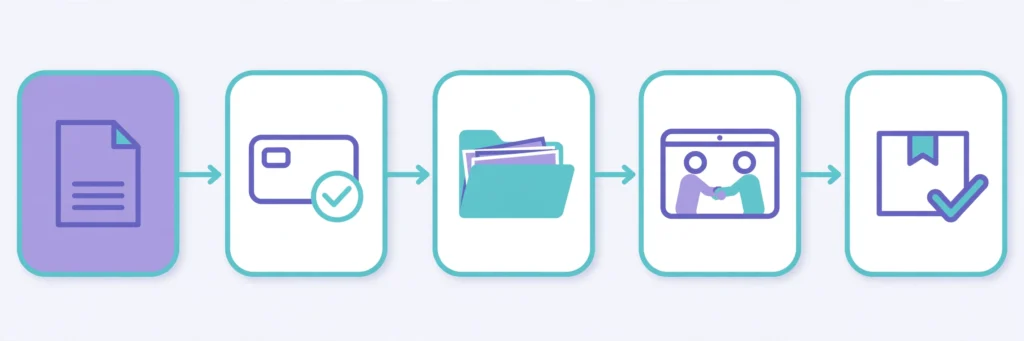
The 48-hour onboarding sequence
The checklist above is the full list. This table is the order to do it in, so the most important protections land first. The client-facing part should complete within five business days: kickoff call within 24 hours, scope and terms confirmed within 48 hours, assets received within a week, and the advance cleared before production begins.
| When | What to do | What it protects |
|---|---|---|
| Hour 0, the day you win it | Send the welcome email with the asset list and the kickoff call booking link. Nothing else. Do not start work. | Sets the tone and stops scope from growing before it is written down |
| Hour 24 | Hold the kickoff call. Send written confirmation of what was agreed within two hours of the call ending. | Confirms scope, approver, and dates while memories are fresh |
| Hour 48 | Send the scope document, communication rules, and invoice terms as one package, plus the advance invoice. | Creates the written record the whole project runs on |
| Day 3 to 5 | Confirm assets received, or send one polite chase with a specific list of what is still missing and what it blocks. | Keeps the project moving without silent delays |
| Advance clears | Production begins. Not before. | Your payment and your time |
The one-page scope document: what goes in it
The scope document, sometimes called a statement of work, is the part of the paperwork you will actually use. When the client asks for something extra in week three, you point to it. When they go quiet after delivery, the acceptance clause in it is what makes your invoice due. One page is enough for most projects. It should let a stranger read it and answer six questions: what is being delivered, in what form and quantity? What is not included? When does each part arrive, and what does the client need to provide first? What does it cost, and when is each payment due? How is each deliverable approved? And how are changes handled?
Write deliverables you can count. “Five-page WordPress website: Home, About, Services, Blog, Contact” is a deliverable. “A nice website” is not. Then write the out-of-scope list. It protects you more than anything else in the document. Name the things a reasonable client might assume are included: copywriting on a design job, stock image licences, hosting, translations, content uploads, and maintenance after launch. Add one line that saves countless arguments: “Any work outside this scope will be quoted separately and started only after written approval.”
Acceptance is the point at which a deliverable counts as done. Give each milestone an objective test where you can: “the site loads on Chrome, Safari and Android Chrome; all forms deliver to the client’s inbox”. Without an acceptance test, “done” is a matter of opinion, and opinions change when the invoice arrives.
The welcome email: copy and adapt this template
Send this within 24 hours of the client saying yes. Replace the bracketed parts with your own details. Keep the tone warm and professional, and keep it short: the client should be able to read it in one minute.
Subject: Welcome aboard, [Client Name]: here is what happens next
Hi [First Name],
Thank you for choosing to work with me. I am excited to get started on [project name]. Here is what happens next:
1. This week: a 30-minute kickoff call on [date and time], where we confirm the plan and the timeline.
2. Before the call: please share [logo files, brand colours, website login] using the link below.
3. After the call: I will send a one-page summary of the scope, the milestones, and the payment schedule, along with the advance invoice.Work begins once the advance is received. My working hours are [hours], and the best way to reach me is [email or WhatsApp]. Looking forward to it.
Best regards,
[Your Name]
Three things make this email work. First, it tells the client exactly what to do next, instead of leaving them wondering. Second, it states plainly that work begins after the advance, so there is no awkward conversation later. Third, it gives the client one channel for communication, which keeps the project out of scattered chats.
The 30-minute kickoff call agenda
Send this agenda with the meeting invite. Thirty minutes is enough if you follow it. The call is for confirming, not discovering: you already sold the work, so do not reopen the price or the scope unless the client raises it.
- Minutes 0 to 2: restate the goal in the client’s words. “You want a website that takes orders from Instagram.” Ask them to correct you. If they correct you, that is the most valuable two minutes of the project.
- Minutes 2 to 7: walk the scope statement line by line. Confirm or amend each deliverable. Write down every amendment and send it in the recap.
- Minutes 7 to 15: review the asset list. Note what is missing, who owns it, and by when it will arrive.
- Minutes 15 to 20: confirm the approval chain. Who gives final sign-off? How does feedback arrive? What is the review window for each deliverable?
- Minutes 20 to 25: confirm communication rules. Working hours, response times, one channel, and what counts as urgent. Agree that changes to the scope go in writing.
- Minutes 25 to 30: confirm the first milestone date and the first invoice date. End by stating the next step and who does it.
Communication rules and file handover
Most freelancer-client friction is not about the work. It is about messages arriving at midnight, feedback arriving in five different places, and files living in a chat that nobody can search. Agree on four rules at kickoff and write them in the recap:
- One channel. Email for decisions and files, WhatsApp or calls for quick questions. Never both for the same decision, because then nobody knows which version counts.
- Working hours and response times. State your hours and a realistic reply time, such as within one working day. Clients respect stated hours; they only test unstated ones.
- Feedback in one place. One email or one shared document per round, from the named approver. Feedback that arrives in three chats from three people is not feedback, it is noise.
- Changes in writing. Any change to the scope is quoted separately and started only after written approval. This protects the client too, because they can see the cost of the change before agreeing to it.
At handover, the file discipline you set at onboarding pays off. Deliver the final files in the client’s folder, in the formats agreed in the scope, with the source files included if that was part of the deal. Keep your own copy, but make sure the client is not dependent on you for access to their own work. A clean handover is what turns a one-time client into a returning one.
A worked example: what good onboarding looks like
This is a hypothetical example shared only to explain the process; actual results may differ. The numbers are invented round figures used to show how milestone maths works, not market rates.
Riya is a freelance graphic designer in Pune. A local cafe owner hires her for a logo and menu design, quoted at Rs 20,000. On day one, Riya sends the welcome email, the asset list, and the kickoff call link. The client shares the old menu and some photos, but no logo files, because there is no old logo. Riya notes that in the recap.
On the kickoff call they agree the scope: one logo with three concepts, two revision rounds, and a two-page menu design. Out of scope: printing, photography, and social media posts. The approver is the cafe owner, not the staff. The review window is five working days per draft. Payment is 50% advance (Rs 10,000) before work begins and 50% (Rs 10,000) on final delivery. The invoice states the total exclusive of GST, and Riya notes that she is not GST-registered, so no GST is added.
The advance clears on day three, so Riya starts work. The first draft goes out on day seven. The owner replies in four days with one round of changes from a single email, because the feedback rule was agreed at kickoff. The final files are delivered on day fourteen, the balance invoice goes out the same day, and the owner pays within the agreed seven days. Nothing in this story is dramatic. That is the point. Good onboarding makes projects boring, and boring projects get paid on time.
Common onboarding mistakes
Starting work before the advance clears. This is the most expensive mistake in freelancing. It teaches the client that your time is free until proven otherwise. If you have already been caught by a client who never paid, read our guide to advance payment fraud targeting freelancers in India to see the checks that prevent it next time.
Skipping the paperwork for small projects. A Rs 5,000 project can create a Rs 50,000 argument when the scope was never written down. The smaller the project, the shorter the agreement should be, but there should still be one: a short email listing scope, fee, advance and delivery date, accepted in writing, is enough.
Accepting feedback from everyone. When the client’s friend, partner, and employee all send changes, you cannot satisfy them all. The agreement should name one approver. If the client wants a second opinion, they can collect it and send you one consolidated list.
Chasing assets without a deadline. “Please send the logo when you get time” means the project waits forever. Give a date, and say what the delay blocks. If the assets do not arrive, the delivery date moves by the same number of days, and the client should know that in writing.
Treating warning signs as onboarding problems. If a client refuses any written agreement, refuses any advance, or pressures you to start unpaid, that is not an onboarding problem. That is a client to avoid. Our guide to ten red flags of fake clients in India helps you spot these clients before you invest a week of work.
What to do when onboarding stalls
Sometimes the client goes quiet after saying yes. Send one polite follow-up after three working days, restating the next step and the one thing you need from them. Send a second one after seven working days, noting that the timeline will shift by the delay. After that, close the file and move on. Do not keep chasing a client who has stopped responding; your time is better spent finding the next one.
If the client stalls on payment, do not start work and do not send drafts. The work is your only leverage, and giving it away before payment removes the reason to pay. If the client stalls on assets, start only the parts that do not need them, and tell the client in writing what is blocked and by when it is needed.
For foreign clients, two extra steps belong in onboarding. First, ask whether they need a W-8BEN form, which most US companies request to avoid withholding tax. Second, keep the e-FIRA or FIRC document for every foreign remittance, because your bank or payment platform issues it as proof of the inward payment, and you will need it for your records.
Frequently asked questions
How long should client onboarding take?
The client-facing part should complete within five business days: kickoff call within 24 hours, scope and terms confirmed within 48 hours, assets received within a week, and the advance cleared before production begins. A simple project can be onboarded in two days. If onboarding drags past two weeks because the client will not confirm the scope or pay the advance, treat that as information about the client, not as a delay to work around.
Do I need a contract for a small freelance project?
You need something in writing, but it does not have to be a formal contract. For a small project, a short email listing the scope, the fee, the advance, and the delivery date, accepted in writing by the client, covers the essentials. For larger or complex projects, a one or two-page agreement with the seven clauses in this article is worth the effort, and a lawyer’s review is sensible when the value is high.
What if the client refuses to pay an advance?
Ask why, and listen. Some genuine clients, especially larger companies, pay only on their own cycle. In that case, agree on a smaller first milestone with a short delivery, so your exposure is limited to a few days of work. But if a small client refuses any advance and any milestone structure, that is a warning sign, not a negotiation point. The advance is not about trust; it is about both sides committing to the project.
Should I charge GST on my freelancing invoices?
If you are GST-registered, yes, and show it as its own line on the invoice. Most professional and creative services attract GST at 18%, but check the SAC code for your service with your CA. If you are below the registration threshold and not registered, say so plainly and do not add GST. For foreign clients, export of services is zero-rated, and with a Letter of Undertaking you invoice without IGST. Tax rules change, so confirm the current position with your CA rather than relying on any article, including this one.
Start every project the same way
Onboarding is not paperwork for its own sake. It is the hour that saves the project. A written scope, a clear payment schedule, a short kickoff call, and one named approver will prevent more freelance problems than any skill upgrade. Build the checklist once, use it for every client, and improve it after every project by adding the one question you wish you had asked at the start.
If you want to go further, the Income Builder programme teaches implementation step by step: how to price your services, find clients, and run projects professionally. See how Income Builder teaches implementation and decide whether it fits where you are right now.
About Padhaku
Padhaku is an India-focused digital skills learning platform founded by Anubhav Shukla. It focuses on making practical digital education more accessible to learners. Padhaku covers freelancing, digital marketing, WordPress, SEO, and online earning, with an emphasis on honest, practical guidance for Indian beginners rather than promises of quick income.
Sources and further reading
- SelfEmployed.com, “Client Onboarding Checklist: A 14-Step Freelancer Guide”, published 12 May 2026, updated 19 June 2026: https://www.selfemployed.com/client-onboarding-checklist-for-freelancers/
- IndieMoney, “How to Onboard a Freelance Client So They Never Ghost You”, published 30 October 2026: https://medium.com/@siteconnectai/how-to-onboard-a-freelance-client-so-they-never-ghost-you-the-intake-questions-proposal-structure-3eb586aec267
- AIXHDD, “Client Onboarding Checklist for Freelancers (5 Docs)”: https://aixhdd.com/client-onboarding-checklist-freelance/
- FreelanceIndia.club, “Statement of work template for Indian freelancers”: https://www.freelanceindia.club/playbooks/statement-of-work-template
- CodeFree, “Freelance Contract in India: 7 Clauses to Include (2026)”: https://www.codefree.cc/blog/freelance-contract-clauses-india-2026
- Xflowpay, “Freelancer Payment Terms 2026: Examples, Best Practices and Contracts”: https://www.xflowpay.com/blog/freelancer-payment-terms