

Amazon cut its India affiliate commissions again in late 2026, and this time the change is big enough to change the maths for beginners. Beauty fell from 10% to 8%. Apparel fell from 10% to 7.5%. Books fell from 5.9% to 4.72%. Electronics fell from 3.5% to 2.8%. And most of the phones Indian readers actually buy – every iPhone, and long lists of Samsung, Redmi, Realme, Vivo and OnePlus models – now pay 0%. If you are planning to earn from Amazon affiliate links, you need the current rates, not the old ones most guides still show. This article gives you the full official rate table for October-November 2026, the comparison with the earlier rates, and honest worked examples so you can decide whether Amazon affiliate links are still worth your time.
The short answer: Amazon Associates in India now pays 0% to 8% depending on the product category, with most everyday categories between 2.5% and 5%. The best standard rates are beauty at 8% and apparel at 7.5%. Mobile phones pay 1% at most, and the most popular phone models pay nothing. You are paid about 60 days after the month ends, and only once you are owed at least Rs 1,000 by bank transfer. For a beginner with small traffic, that usually means a few hundred rupees a month at first, not a salary. It can still be worth doing as one income stream among others, but only if you pick the right categories and understand the rules.
Padhaku teaches practical digital skills to Indian beginners, and affiliate income is one of the most misunderstood topics our readers ask about. This guide uses Amazon’s own published fee schedule, checked on 10 November 2026, and shows the maths step by step.
What changed: the cuts, in one comparison
Amazon publishes its India commission rates two months at a time, and it can change them whenever it wants. The schedule that ran in August 2026 paid more in almost every category than the schedule for October-November 2026. Here is the change in the categories beginners care about most.
| Category | August 2026 rate | October-November 2026 rate | What changed |
|---|---|---|---|
| Beauty and luxury beauty | 10% | 8% | Down 2 percentage points |
| Apparel, shoes, luggage, watches | 10% | 7.5% | Down 2.5 percentage points |
| Books, toys, baby products, automotive, sports | 5.9% | 4.72% | Down 1.18 percentage points |
| Kitchen, furniture, home | 5% | 4% to 4.25% | Down about 1 percentage point |
| Grocery and Amazon Fresh | 4.7% | 2.5% | Down 2.2 percentage points |
| Electronics and computers | 3.5% | 2.45% to 2.8% | Down about 1 percentage point |
| Mobile phones | 1% | 1%, but many models now 0% | Same headline rate, wider 0% list |
Two things matter here. First, every cut is a real cut in what you take home. On Rs 1,00,000 of beauty product sales, 10% meant Rs 10,000 and 8% means Rs 8,000. That is Rs 2,000 less for the same work. Second, the old rates are still shown on most blogs and YouTube videos about Amazon affiliate income in India, because those pages were written before the change and never updated. If a guide tells you beauty pays 10%, it is showing you the old schedule. Always check the date on the rate table, and check Amazon’s own fee schedule before you plan anything. The official page is linked in the sources section at the end of this article.
There is also a pattern worth noticing. The cuts hit the categories beginners are most often told to target. Grocery was nearly halved. Electronics, the category behind most “best gadgets” blogs, pays under 3%. The message is simple: Amazon is paying less for the traffic it already gets easily, and it is paying nothing at all for the products it does not need affiliates to sell.
The full Amazon affiliate commission table for India (October-November 2026)
The table below is copied from Amazon’s own Advertising Fee Schedule for October-November 2026, published on Amazon.in Associates Central and checked on 10 November 2026. Rates are a percentage of the qualifying purchase price, and they change every two months, so treat this as the current table, not a permanent one.
| Product category | Commission rate |
|---|---|
| Beauty and luxury beauty | 8% |
| Apparel and accessories, luggage and bags, watches | 7.5% |
| Jewelry, shoes and handbags | 7% |
| Automotive, baby products, books, personal care appliances, sports and fitness | 4.72% |
| Home, home improvement, office products | 4.25% |
| Furniture, health, household and personal care, kitchen and dining, pet supplies | 4% |
| Wireless accessories | 3.4% |
| Musical instruments | 3.2% |
| Business and industrial supplies | 2.98% |
| Electronics, lawn and garden, video games | 2.8% |
| Camera | 2.63% |
| Amazon Fresh and grocery | 2.5% |
| Computers, home entertainment, large appliances | 2.45% |
| Mobile phones | 1% |
| Bill payments | 30% (up to Rs 3 per transaction) |
| All other categories | 5% |
Read the table with two warnings. First, the category that pays most is not always the category that earns most. Beauty pays 8%, but a beauty product often costs Rs 300 to Rs 800, so one sale earns Rs 24 to Rs 64. A laptop pays only 2.45%, but on a Rs 50,000 laptop that is Rs 1,225. Rate and price work together, and the worked examples below show how. Second, the table is only the starting point. Amazon also publishes model-level exceptions and a list of products that pay nothing at all, and those exceptions decide whether your specific links earn anything.
The 0% traps: products that pay nothing
This is the part most guides skip, and it is the part that costs beginners the most. A 1% headline rate for mobile phones sounds small but workable. In practice, most of the phones your readers will buy pay 0%.
All iPhone models pay 0%. Amazon’s differential phone table for October-November 2026 lists every iPhone model at 0%. If your content recommends iPhones, your Amazon links on those products earn nothing, however many people buy through them.
Most popular Android phones also pay 0%. The same table lists long model lists at 0%, including many Samsung Galaxy A and M series phones, Redmi Note models, Realme Narzo models, Vivo V and Y series phones, OnePlus Nord models, iQOO Neo models, Motorola Razr models and Poco models. A small number of newer models pay 2%, 1.5% or 0.5%, and the rest of the mobile phone category pays 1%. Before you write a phone recommendation, check the model against the current differential table. A phone article that sends readers to 0% models earns nothing, and the writer usually finds out months later, when the earnings report arrives.
Apple products beyond phones pay 0% too. MacBooks, Apple Watch, iPads and PC accessories are listed at 0% in the October-November 2026 schedule.
Cheap audio pays 0%. All earphones, headphones, speakers and audio accessories below Rs 3,000 MRP pay 0%, and headsets from listed brands including Apple, Xiaomi, OnePlus, Realme, Vivo and Portronics pay 0%. This matters because budget earphones are one of the most common affiliate recommendations in India, and most of them fall under the Rs 3,000 line.
Some home appliances pay 0%. All microwaves and semi-automatic washing machines pay 0%.
Some products are excluded entirely. You earn no fee at all on flight bookings, gift cards, video game consoles and hardware, Prime membership, Kindle eBooks, and gold and silver coins.
The lesson is not that Amazon affiliate marketing is dead. It is that the category decides the income, and the category is decided by the exact product, not by the general topic. A “best headphones under Rs 2,000” article and a “best headphones under Rs 5,000” article look similar, but one pays 0% on most products and the other pays 2.8% on electronics. Check the product, not just the category.
How a click becomes money (and how it does not)
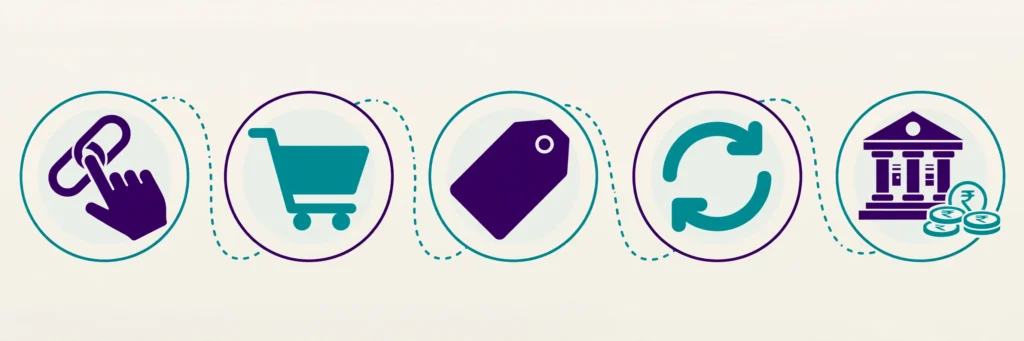
The commission rate is only one of five steps between a reader clicking your link and money reaching your bank account. Beginners usually learn the rate and ignore the other four, then wonder why the earnings are lower than the maths suggested.
Step 1: the 24-hour session. When someone clicks your affiliate link, Amazon starts a session that lasts up to 24 hours. The sale only counts if the buyer completes the purchase inside that session. The session also ends early if the buyer places an order or clicks another affiliate’s Amazon link first. This is why Amazon affiliate income depends on buyers who are ready to purchase, not just readers who are browsing.
Step 2: the cart extension. If the buyer adds an item to the cart within those 24 hours, that item can still earn you a fee if they order it later, within the cart window. Amazon’s help pages describe this window as 90 days, while the operating rules phrase it as 89 days. Either way, the extension applies only to items added to the cart during the first 24 hours, not to anything the buyer adds later.
Step 3: qualifying revenue, not the order total. Your percentage applies to qualifying revenue, not to the full amount the buyer paid. Amazon excludes shipping, handling, gift-wrapping fees, taxes and service charges, and then subtracts rebates, credit card processing fees, returns and bad debt. A Rs 1,000 order with Rs 100 of tax and Rs 50 of shipping does not earn a fee on Rs 1,000. It earns a fee on the qualifying part, which is lower.
Step 4: returns remove the fee. If the buyer returns the product, the fee is taken back. Categories with high return rates, such as apparel and shoes, lose a bigger share of their headline rate than categories with low return rates, such as books.
Step 5: the payout rules. Amazon works out fees monthly, and pays about 60 days after the end of the month. By bank transfer (NEFT), it will not send payment until you are owed at least Rs 1,000. By cheque, the minimum is Rs 2,500. Anything below the minimum rolls over to the next month. So January’s earnings, if they cross Rs 1,000, reach your bank around the end of March.
There is one more rule for new accounts. Amazon reviews your account after you join, and if you do not generate 3 qualifying sales within your first 180 days, the account is deactivated. Three sales is a low bar, but it means you need real buyers, not just clicks, in your first six months.
Honest math: three worked examples
The examples below are hypothetical, shown only to explain the maths. They use round numbers and stated assumptions. Actual results will differ, because your traffic, conversion rate, product mix and return rate will all be different. No example here is a promise of income.
Example 1: a small beauty blog. Suppose a beginner beauty blog sends 1,000 clicks to Amazon in a month. Suppose 40 of those clicks turn into purchases, which is a 4% conversion rate, and the average order is Rs 700 of beauty products at 8%. The gross fee is 40 x 700 x 0.08 = Rs 2,240. Suppose 10% of those orders are returned, which removes about Rs 224, leaving roughly Rs 2,016. That crosses the Rs 1,000 payout minimum, and it would be paid about 60 days after the month ends. It is real money, but it is roughly Rs 2,000 for a month of work, before the cost of running the blog.
Example 2: a book recommendation blog. Suppose a book blog sends 500 clicks in a month, 25 people buy books, and the average book order is Rs 450 at 4.72%. The gross fee is 25 x 450 x 0.0472 = Rs 531. That is below the Rs 1,000 minimum, so nothing is paid that month. The balance rolls over, and the blogger is paid only when the total crosses Rs 1,000. A low-price category needs far more volume than a beginner expects: at these numbers, the blog needs about 950 clicks a month to cross the payout line.
Example 3: a phone deals page, and the 0% trap. Suppose a deals page sends 200 clicks and 10 people buy phones at an average of Rs 18,000. If those phones are iPhones or the listed Samsung, Redmi, Realme, Vivo or OnePlus models, the fee is 10 x 18,000 x 0 = Rs 0. If they are unlisted models at 1%, the fee is 10 x 18,000 x 0.01 = Rs 1,800. The same traffic, the same effort, and the result depends entirely on which models the readers bought. This is why a phone deals page can look busy and earn nothing.
Now compare the three examples. The beauty blog earned the most per click, the book blog earned the least per click but with the most reliable rate, and the phone page earned either a good fee or nothing, depending on the model list. The maths says: pick categories where the rate, the price and the return rate work together, and never build a page around products you have not checked against the current schedule.
Bounties: the other way Amazon pays
Commissions are not the only payment. Amazon also pays fixed bounties when a reader completes a specific action through your link, even if they buy nothing. For October-November 2026, the bounty table lists: Prime paid membership Rs 100, Prime Video paid membership Rs 100, Amazon Business registration Rs 200, Audible free trial Rs 150, Audible paid membership Rs 150, Prime Music first stream Rs 100, Prime Music paid membership Rs 100, Sell on Amazon completed registration Rs 10, and Sell on Amazon registration with GST validation Rs 400.
Bounties are worth knowing about for one reason: they pay a fixed amount, so they do not shrink when Amazon cuts percentage rates. A Rs 150 Audible trial bounty is the same whether the rate table changes or not. But bounties have their own limits. The reader must be eligible, must complete the exact action, and must not already be a member. Do not build a content plan around bounties alone, and never present a bounty as a sale or as income you have already earned. It is a small, fixed payment for a completed sign-up, and it should be described exactly that way.
When you actually get paid
Put the whole timeline together and the wait is longer than most beginners expect. Say you start in November and make your first sales in December. Amazon works out December’s fees at the end of December. If your balance is above Rs 1,000, payment is sent about 60 days after the end of December, which is around the end of February. From first click to first bank credit, three to four months is normal. If your balance is below Rs 1,000, it rolls over and the wait is longer.
This timing matters for planning. Amazon affiliate income cannot pay next month’s bills. It is a slow, monthly, delayed income stream, and it only becomes regular once you have steady traffic every month. Anyone who shows you a screenshot of a single good month and calls it a monthly income is showing you the best month, not the average. Our guide to affiliate marketing scams in India explains how to read those screenshots and what they usually leave out.
Is Amazon affiliate marketing still worth it? A decision framework
The honest answer depends on what you already have. Use this framework instead of a yes or no.
Worth trying if: you already have a blog, YouTube channel or Instagram page with readers who trust your recommendations; you write about categories that still pay, such as beauty, apparel, home, kitchen or books; you can publish consistently for at least six months; and you treat it as one income stream, not your only one. In that case, Amazon links add income to work you are already doing.
Probably not worth starting from zero if: you have no audience yet, you want income in the next two months, or your topic is phones, Apple products, budget audio or gaming consoles, where the rate is 1% or 0%. Building an audience from zero takes months, and the payout delay adds two more months on top. A beginner with no audience is usually better off learning a skill first and adding affiliate links later, when readers already exist.
The category picker. Before you write a single recommendation, answer three questions about the product: What is its exact rate in the current schedule? What is its typical price? What is its likely return rate? A product passes the test if the rate is 4% or more, the price is high enough that one sale earns at least Rs 50 to Rs 100, and returns are not so common that they eat the fee. Beauty, home and kitchen products often pass. Phones, Apple products and budget audio usually fail.
Your 30-day reality check. Before you spend a month on Amazon affiliate content, do this short exercise and write down the answers. (1) List the 10 products you would recommend, and look up each one’s exact rate in the current schedule. How many pay 0%? (2) Estimate your monthly clicks honestly. If you have no audience, assume under 500 clicks, not 10,000. (3) Multiply clicks by a 2% to 4% purchase rate, then by your average order value, then by your average rate. That is your rough monthly fee, before returns. (4) Compare it with the Rs 1,000 payout minimum. If your estimate is below Rs 1,000, you will not be paid in month one, and that is normal. (5) Decide whether the work is worth that number. If it is not, change the category or the plan, not the maths.
If the framework says no, that is a useful answer. Other income routes exist, and some suit beginners better. Selling your own digital product, for example, pays you the full price minus platform fees, instead of a small percentage of someone else’s sale. Our guide to making and selling digital products in India explains that route, including how to write a refund policy, which protects you when buyers ask for their money back. And if you are new to affiliate marketing as a whole, start with our beginner’s guide to affiliate marketing in India, which explains the models, the networks and the realistic timelines before you pick a single product.
Common mistakes beginners make
Using old rates. The most common mistake is quoting 10% for beauty or apparel from a guide written before the cuts. Check the current schedule every two months, and put the schedule’s date in your notes.
Promoting 0% products. iPhones, listed phone models, Apple accessories, budget audio under Rs 3,000 and gift cards all pay nothing. A recommendation page full of them earns nothing, however good the traffic is.
Counting the order total as your base. Your fee is a percentage of qualifying revenue, not the order total. Taxes, shipping and returns all reduce it. The gap between the order total and the qualifying revenue is usually 10% to 20%, and beginners who ignore it overestimate their income by the same amount.
Expecting payment next month. Payment comes about 60 days after the month ends, and only above Rs 1,000. Plan for a three to four month wait from your first sale to your first bank credit.
Hiding the affiliate relationship. If you earn a fee when readers buy through your links, say so clearly near the links. Readers trust you more when you disclose, and disclosure is also a legal expectation in India. Our guide to affiliate disclosure in India gives you copy-paste disclosure lines for a blog, YouTube and Instagram.
Buying a course before earning a rupee. Many courses promise to teach Amazon affiliate secrets for a high fee, and most of them repeat the same public information in this article. Before you pay anyone, read our guide to the red flags in fake affiliate marketing courses. The fee schedule is free, the sign-up is free, and the first three sales are the real test, not a certificate.
Frequently asked questions
What is the highest Amazon affiliate commission rate in India now?
Beauty and luxury beauty pay 8%, which is the highest standard product rate in the October-November 2026 schedule. Bill payments pay 30%, but only up to Rs 3 per transaction, so it is not a meaningful income source.
Do iPhones pay any Amazon affiliate commission in India?
No. All iPhone models pay 0% in the October-November 2026 schedule. Many popular Samsung, Redmi, Realme, Vivo, OnePlus and iQOO models also pay 0%. Check the model in the differential phone table before you promote it.
How long does the Amazon affiliate cookie last in India?
The session lasts up to 24 hours from the click. If the buyer adds an item to the cart within those 24 hours, that item can still earn a fee if ordered later, within the cart window, which Amazon’s help pages describe as about 90 days.
What is the minimum payout for Amazon Associates in India?
Rs 1,000 by bank transfer (NEFT) and Rs 2,500 by cheque. Payment is sent about 60 days after the end of the month in which the fees were earned, and only once the balance crosses the minimum.
Can a beginner still earn from Amazon affiliate marketing in India?
Yes, but slowly and in small amounts at first. You need an audience, products in categories that still pay, and at least 3 qualifying sales in your first 180 days to keep the account. Treat it as one income stream, not a salary, and check the current rate schedule every two months.
Do Amazon affiliate rates change often?
Yes. Amazon publishes the India schedule two months at a time and says it may change rates, exclude products or add products at any time. The late-2026 cuts are the latest example. Never plan income on a rate you checked months ago.
If you want a structured way to learn affiliate marketing properly, explore the free resources on Padhaku, which cover the basics before you spend money on any course or tool.
About Padhaku
Padhaku is an India-focused digital skills learning platform founded by Anubhav Shukla. It focuses on making practical digital education more accessible to learners. This article was written to give Indian beginners honest numbers about affiliate income, with sources you can check yourself, instead of the screenshots and promises that dominate this topic.
Sources and further reading
- Amazon.in Associates Central – Advertising Fee Schedule (October-November 2026): the official rate table, the mobile-phone differential table, the 0% product lists, the excluded products and the bounty table. Checked 10 November 2026.
- Amazon.in Associates Central – Payment methods: payment about 60 days after the month ends; NEFT minimum INR 1,000; cheque minimum INR 2,500. Checked 10 November 2026.
- Gaurav Tiwari – Amazon Affiliate Program: How to Join, Rates and Rules (2026): the August 2026 India rate table used for the cut comparison, the 24-hour session and 89-day cart window, and the payment thresholds.
- Lilach Bullock – Amazon Associates India: Commission Rates and Payout Rules (updated 2 November 2026): an independent check of the October-November 2026 rates, the 24-hour session and the payout rules.
1 Comment.