
Your first 1,000 subscribers are the hardest subscribers you will ever earn. A new channel has no back catalogue, no audience to tell YouTube what it is about, and no data to learn from. Every video starts from zero. This guide from Padhaku gives you a practical 90-day plan for that stage: what to publish each week, how to mix Shorts and long videos, and which numbers to check so you know whether the plan is working.
The short answer is this: pick one clear topic, publish two long videos and three Shorts every week, make every title and thumbnail answer a real search or a real curiosity, and review your analytics every month to repeat what worked. Do that for 90 days and you will have about 24 long videos and 30 Shorts, a channel YouTube can understand, and a real shot at 1,000 subscribers. Nothing here guarantees the number in 90 days. The plan is a suggested practice schedule, and your result depends on your niche, your language, your consistency and some luck. What the plan does guarantee is that you will finish 90 days with a channel that is much stronger than one built on random uploads.
What 1,000 subscribers actually unlocks
One thousand subscribers matters because it is one half of the YouTube Partner Program, the programme that lets a channel earn money from YouTube itself. The other half is watch time. Both halves have to be met, and meeting them does not automatically get you accepted. YouTube reviews every channel that applies, and the review typically takes about a month.
| Milestone | What YouTube requires | What it unlocks |
|---|---|---|
| 500 subscribers | 500 subscribers, 3 public uploads in the last 90 days, and either 3,000 qualified watch hours on long videos in the last 365 days or 3 million qualified Shorts views in the last 90 days | Channel memberships, Super Chat and Super Stickers, Super Thanks, Shopping |
| 1,000 subscribers | 1,000 subscribers and either 4,000 qualified watch hours on long videos in the last 12 months or 10 million qualified Shorts views in the last 90 days | Everything above, plus Watch Page ads, Shorts Feed ads and YouTube Premium revenue |
Three rules in that table decide how you should plan. First, Shorts views do not count toward the 4,000 watch hours. Only watch time on public long videos counts, and private, unlisted, deleted and ad-driven views do not count either. Second, views and watch time from paid ad campaigns do not count toward the thresholds at all. Third, you also need to follow the channel monetization policies, have no active Community Guidelines strikes, have 2-Step Verification turned on, and have an AdSense for YouTube account linked. The subscriber count is the visible goal, but the watch hours are the quieter half of the job, and this plan works on both at once.
The honest truth about reaching 1,000 subscribers “fast”
Search for this topic and you will find two kinds of promises: courses that claim a shortcut, and videos that claim one trick changed everything. Both hide the same fact. A new channel grows slowly at first because YouTube has almost no signals about who should see it. The first videos are experiments that produce data, not results. Creators who grow steadily usually describe the same shape: a long quiet stretch, then one or two videos that take off, then faster growth because the channel finally has an audience to build on. That shape is normal, and it is why the plan below is 90 days long instead of 30.
Two shortcuts are worth ruling out now. Buying subscribers does not help and puts the channel at risk. Bought subscribers do not watch your videos, so they add nothing to watch time, and YouTube treats artificial engagement as a policy violation. Sub-for-sub schemes have the same problem: they collect people who will never watch, and a subscriber who never watches tells YouTube your videos are not worth recommending. The only subscribers that move a channel forward are people who found a video, watched it, and decided they want the next one.
A realistic way to think about the 90 days: you are not chasing a number, you are building a small library of useful videos, learning which topics your audience responds to, and giving YouTube enough consistent signals to show your videos to the right people. If you reach 1,000 subscribers inside the 90 days, good. If you reach 400 with strong watch time and a clear direction, the next 90 days will be much easier than the first. Either way, the work in this plan is the work that has to happen first.
Before day 1: lock in a niche you can sustain
A 90-day plan only works if you can make videos about the same topic for 90 days without running out of ideas or interest. That decision comes before the plan, and it is worth a full day of thought. If you have not chosen yet, work through our guide to choose a YouTube niche first. It gives you a 7-step framework and a scoring matrix for testing ideas against demand, competition, your own advantage and money paths.
Three quick tests settle the choice. First, can you list 30 video ideas in your niche right now, without searching for inspiration? If not, the niche is too narrow or too unfamiliar. Second, can someone describe your channel in one sentence after watching one video? If not, the niche is too broad. Third, would you still make videos about this topic in month six, when the views are still small? If the answer is no, pick something else. Language is part of the same decision. A Hindi channel reaches a huge audience in India and faces less competition in many topics than an English one, but it also changes which brands and affiliate programmes will fit later. Pick the language you can speak naturally on camera, because you will be speaking it twice a week for months.
Do not wait for better equipment. A phone camera, daylight from a window, and a quiet room are enough for the first 24 videos. Many successful Indian creators started exactly that way, and viewers forgive simple production when the information is clear. Spend your first week on the niche and the setup, not on shopping for gear.
The 90-day plan at a glance
The plan has four phases of roughly three weeks each, with a different job in each phase. The table below is the whole plan on one page. The subscriber checkpoints are planning targets to aim at, not measured averages and not promises. Actual numbers vary widely by niche, language and consistency.
| Phase | Weeks | The one job | Content target | Subscriber checkpoint |
|---|---|---|---|---|
| Foundation | 1-2 | Decide what the channel is and prove you can publish | 4 long videos, channel setup finished | 0-50 |
| Findability | 3-4 | Become discoverable: searchable topics, clickable packaging | 4 long videos, 6 Shorts | 50-150 |
| Rhythm | 5-8 | Hold a steady pace and learn from the data | 8 long videos, 12 Shorts | 150-400 |
| Momentum | 9-12 | Repeat what worked and reach new viewers | 8 long videos, 12 Shorts | 400-1,000 |
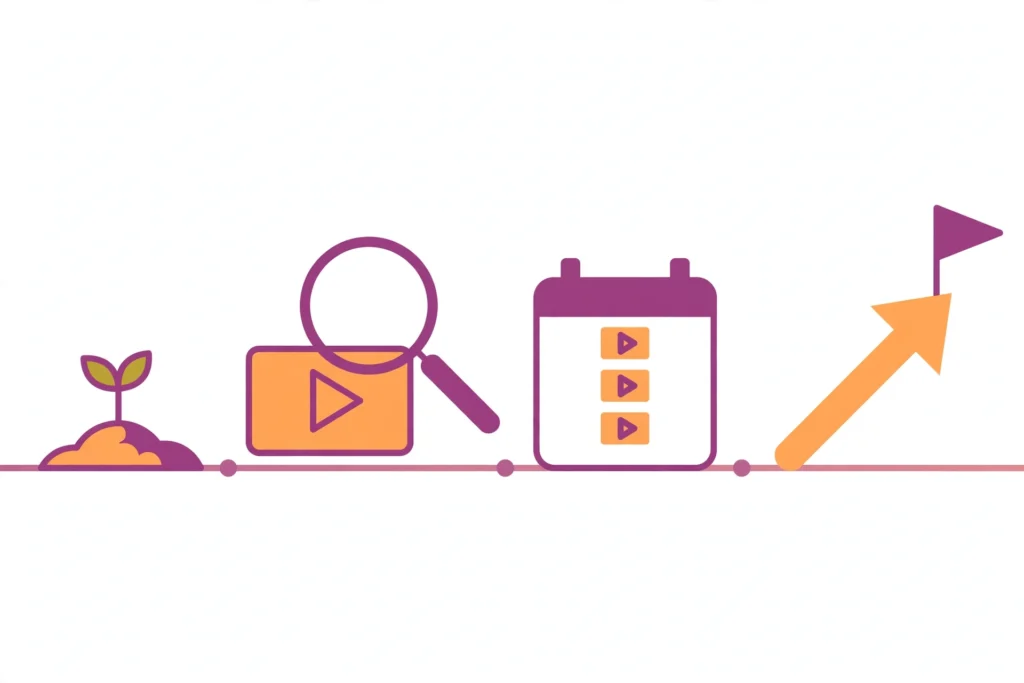
The weekly rhythm from week 3 onward is two long videos and three Shorts. That is about 5 to 7 hours of work a week once you have a routine, including scripting, filming, editing and thumbnails. If you have less time, do one long video and two Shorts a week and stretch the plan to six months. A slower plan you actually finish beats a fast plan you abandon in week 4.
Weeks 1-2: Foundation (0-50 subscribers)
The job in these two weeks is to decide what the channel is and to prove to yourself that you can publish. Most new channels stall here not because the videos are bad, but because the creator keeps preparing and never uploads.
Set the channel up once, in an hour, then stop
Pick a channel name people can spell after hearing it once. Write a channel description that says who the videos are for and what they will learn, using the words those viewers would actually search for. Make a simple banner that states the topic in one line, and use a clear photo or logo as the channel icon. Turn on 2-Step Verification on your Google account and check your feature eligibility in YouTube Studio, because the Partner Program needs both later. Then stop adjusting the setup. A banner will not bring subscribers. Videos will.
Publish your first 4 long videos
Choose four topics your target viewer is already searching for. How-to and explainer topics work best at this stage because they match real searches: “how to” questions, beginner guides, and common problems in your niche. Keep each video focused on one question and aim for 6 to 12 minutes. Write the title before you film, and open the video by saying what the viewer will learn in the first 15 seconds. Do not wait for a perfect first video. Your first ten uploads are experiments that generate data, so vary one thing at a time, topic, length or hook style, and keep the rest steady so the comparison means something.
At this stage your subscribers will mostly be friends, family and the occasional search visitor. That is normal. The goal of weeks 1 and 2 is four published videos and a channel that looks finished when a stranger lands on it.
Weeks 3-4: Findability (50-150 subscribers)
Now the job changes. You have videos, but almost nobody can find them. These two weeks are about search and packaging: picking topics people look for, and presenting them so people click.
Pick topics from real searches
Use the YouTube search bar itself. Type the first words of a topic and read the suggestions that appear. Those suggestions are real searches by real viewers. Pick the ones that fit your niche and that you can answer better than the videos already ranking. YouTube Studio search data and the free version of tools like TubeBuddy or vidIQ can add ideas, but the search bar alone is enough to build a list of 20 topics. Avoid chasing a trending topic that has nothing to do with your niche. A viral video outside your niche brings viewers who will never subscribe to your normal content.
Start Shorts, and learn the thumbnail habit
Publish your first six Shorts in these two weeks, three per week. The simplest Shorts to start with are 30 to 60 second versions of your long videos: one tip, one answer, one common mistake. End each Short with a line that points to the full video. At the same time, start treating thumbnails as part of the video, not an afterthought. Use a clear close-up or a simple visual, three or four words at most, and colours that stay readable on a small phone screen. A good thumbnail does not need design skill. It needs one clear idea.
Weeks 5-8: Rhythm (150-400 subscribers)
This is the longest phase and the one where most channels either build a habit or quietly stop. The job is to hold the weekly rhythm, two long videos and three Shorts, and to start learning from the numbers instead of guessing.
Build series, not one-off videos
Group your videos into small series of three or four on one sub-topic, and put them in a playlist. A viewer who finishes one video should see the next one waiting. Playlists also help YouTube understand what your channel is about, and they turn a single view into two or three. End screens matter here too. Point the end screen at the next video in the series, not at a random popular video, so the viewer keeps watching inside your channel.
Use community posts to stay visible between uploads
Community posts, polls and short updates in YouTube Studio, become available once your channel has advanced features enabled. Use them between uploads to ask your small audience a question, share a behind-the-scenes photo, or let them vote on your next topic. A poll that gets 20 votes from 200 subscribers tells you more about what they want than a hundred views on a random video. Keep posts short and useful, and do not use them to beg for subscribers.
Check your analytics for the first time, properly
At the end of week 8, open YouTube Studio and look at three things. First, which videos brought the most subscribers, in the Analytics subscribers report. Second, which videos have the highest click-through rate, which tells you the title and thumbnail worked. Third, which videos hold viewers longest, which tells you the content delivered on the promise. Make a short list of your best two videos and plan the next month around topics like them. Do not judge a video by views alone. A video with modest views and strong watch time is worth repeating. A video with high views and viewers leaving in 30 seconds is a packaging win and a content problem.
Weeks 9-12: Momentum (400-1,000 subscribers)
By now you have about 16 long videos and 18 Shorts, and you know which topics work. The job in the final phase is to repeat what worked, reach new viewers, and remove the friction that stops people subscribing.
Double down on your best format
Take your best-performing video and make two or three follow-ups on the same theme: a part 2, a common-mistakes version, a version for a different level of viewer. Growth at this stage usually comes from one format repeated well, not from constant novelty. If Shorts brought most of your subscribers, keep making them, but remember they do not build watch hours. Pair every Short that performs well with a long video on the same topic, so the new viewers have somewhere longer to go.
Collaborate small, and ask for the subscribe
Reach out to two or three creators at your own size in a related niche and suggest a simple collaboration: a shared topic covered from two angles, or a guest appearance in each other’s video. Small collaborations work because both audiences are similar in size and genuinely curious. Also, start asking for the subscribe clearly and once per video, near the end, after you have delivered value. A simple line works: “If this helped, subscribe, because the next video in this series comes out on Thursday.” Vague pleading at the start of a video does not. And check the basics: a channel trailer for new visitors, a subscribe watermark on videos, and a consistent upload day so viewers know when to return.
Shorts vs long videos: the balance that actually works
Shorts and long videos do different jobs, and the plan needs both. Shorts are discovery. They reach people who have never heard of you, they are quick to make, and they can bring subscribers fast. Long videos are depth. They build watch time, they build trust, and they are the only route to the 4,000 watch hours. A channel that makes only Shorts can reach 1,000 subscribers and still be nowhere near monetization, because Shorts views do not count toward the watch-hour threshold. A channel that makes only long videos grows more slowly, because long videos are harder for a new channel to get discovered.
| Format | What it is good for | What it cannot do | How much in this plan |
|---|---|---|---|
| Shorts (under 60 seconds) | Reaching new viewers fast, testing topic ideas cheaply | Build watch hours toward the 4,000-hour threshold | 3 per week from week 3 (30 total) |
| Long videos (6-12 minutes) | Watch time, trust, search traffic that keeps working for months | Grow as fast as Shorts in the first weeks | 2 per week (24 total) |
A practical rule: never publish a Short without a long video it can point to. If a Short about “3 mistakes in your first Upwork proposal” does well, the long video “Upwork Proposal Template for Beginners” should already exist or be next in your schedule. That link between the two formats is what turns a Shorts viewer into a subscriber, and a subscriber into watch time.
Titles, thumbnails and hooks that earn the click
A viewer decides in about two seconds, from a title and a thumbnail on a phone screen. Everything else in the video only matters after that click. Three habits make the difference.
- Write the title and thumbnail idea before you film. If you cannot state the video in one clear line, the video is not ready to film. Good titles promise one specific thing: “How to Write Your First Upwork Proposal” beats “My Freelancing Journey Part 4” because it answers a search and a need.
- Keep the thumbnail to one idea. One face or object, three or four words, and a background that does not fight the subject. Test it at phone size before you publish. If you cannot read it on your own phone, a stranger will not read it either.
- Hook the first 15 seconds. Say what the viewer will get and why it matters, then start delivering. Long introductions, channel greetings and apologies for the audio quality all lose viewers before the useful part begins. You can improve audio and editing later. You cannot recover a viewer who left in the first 20 seconds.
Avoid clickbait that the video cannot deliver. A misleading title may win one click, but viewers leave quickly, and that short watch time tells YouTube the video was a bad recommendation. The same title that earns a click and keeps a viewer for six minutes is worth ten titles that earn a click and lose the viewer in thirty seconds.
Turning viewers into subscribers
Views and subscribers are different things. A viewer subscribes when they expect the next video to be useful too. That expectation is built by consistency, not by a subscribe button animation. Four things help most at this stage.
- Publish on the same days each week, and say so in your videos. A viewer who knows a new video arrives every Tuesday and Friday has a reason to subscribe instead of hoping to find you again.
- End every video with the next step. Name the next video in the series and put it on the end screen. A viewer who clicks through to a second video is far more likely to subscribe than one who watches a single video and leaves.
- Reply to early comments. In the first months, every comment is a real person who chose your video. A short, genuine reply turns a viewer into a regular, and regulars are the people who subscribe and return.
- Make a short channel trailer, 60 to 90 seconds, that says who the channel is for and what they will get. New visitors who watch the trailer and then watch a video subscribe at a much higher rate than visitors who land on a channel page with no introduction.
What to check on day 30, 60 and 90
Analytics only help if you check them on a schedule and act on what you see. Three checkpoints are enough for the first 90 days. At each one, spend an hour in YouTube Studio and write down what you find, so the next month’s plan is based on evidence, not memory.
| Checkpoint | What to check | What a healthy sign looks like | What to change if it is missing |
|---|---|---|---|
| Day 30 | Subscriber sources, click-through rate, average view duration | Some videos found through search, one or two videos clearly ahead of the rest | If nothing is found through search, retitle older videos around real search phrases and improve thumbnails |
| Day 60 | Top videos by subscribers gained, traffic sources, audience retention curves | A clear best topic or format, and viewers staying past the first minute | If retention drops in the first 30 seconds, shorten your introductions and get to the point faster |
| Day 90 | Total subscribers, total watch hours, best series, Shorts vs long contribution | Watch hours growing alongside subscribers, and one series doing most of the work | If subscribers grew but watch hours did not, shift the mix toward long videos; if watch hours grew but subscribers did not, fix end screens and the subscribe ask |
Do not check analytics every day. Daily numbers on a small channel are mostly noise, and watching them all day is the fastest way to burn out. Once a week is enough while you are publishing, and the three checkpoints above are when you make decisions.
A worked example: one channel, 90 days
This is a hypothetical example, made up only to show how the plan works in practice. The person is fictional and the numbers are illustrative. Actual results will differ.
Priya is a fictional beginner from Nagpur who wants to start a Hindi cooking channel. She films on her phone in her own kitchen, and she can give the channel about 6 hours a week. In weeks 1 and 2 she sets up the channel, names it around simple home cooking, and publishes four videos: “Aloo Paratha Recipe for Beginners”, “5 Breakfast Ideas in 15 Minutes”, “How to Store Spices the Right Way” and “Simple Dal Fry Recipe”. She gets 32 subscribers, mostly family and a few search visitors.
In weeks 3 and 4 she adds Shorts. Each Short is one tip from a long video: a 40-second clip on keeping parathas soft, one on chopping onions without tears. Her Short on soft parathas reaches 8,000 views, and her subscribers climb to about 140. In weeks 5 to 8 she settles into the rhythm, two long videos and three Shorts a week, grouped into a “15-Minute Breakfast” series. Her day-60 check shows the breakfast series brings most subscribers, while a festival sweets video barely moved. She drops the sweets idea and plans three more breakfast videos.
In weeks 9 to 12 she makes follow-ups to her best breakfast videos, collaborates with a small Hindi home-tips creator of similar size, and adds a channel trailer. She ends day 90 with roughly 900 subscribers and about 1,800 watch hours. She has not reached 1,000 subscribers or 4,000 watch hours yet, and that is a realistic outcome, not a failure. She has 24 long videos, a series that works, and a clear direction. Her next 90 days start from a far stronger position than her first day did, and the subscriber goal is now a matter of continuing the same system.
Common mistakes that slow the first 1,000
| Mistake | Why it hurts | What to do instead |
|---|---|---|
| Uploading once, then disappearing for a month | YouTube has no fresh signals and viewers forget the channel | Pick a pace you can hold for 90 days and protect it |
| Mixing three unrelated topics on one channel | Each video reaches a different audience, so none of them subscribes | One channel, one niche; start a second channel only if the first works |
| Making only Shorts | Subscribers grow but watch hours stay near zero | Pair every Short with a long video on the same topic |
| Copying a big creator’s style instead of your own topic | You compete with their production quality instead of your own knowledge | Compete on clarity and usefulness, which a beginner can win |
| Long introductions before the useful part | Viewers leave in the first 30 seconds and the video stops being recommended | State the promise in the first 15 seconds, then deliver it |
| Judging videos by views alone | A viral view count can hide terrible retention | Judge by average view duration and subscribers gained per video |
| Buying subscribers or joining sub-for-sub groups | Fake subscribers never watch, and the channel risks policy action | Earn subscribers one video at a time; slow growth that watches is worth more than fast growth that does not |
| Paying for an expensive course before testing | You may pay to learn a niche you will abandon | Test free first for 30 days; spend only when you know the direction |
Tools you actually need
You need fewer tools than most guides suggest. YouTube Studio, which is free and built in, covers analytics, comments, thumbnails and scheduling. Your phone covers filming and basic editing, and free editors like CapCut or YouTube’s own editor cover cuts and captions. Canva’s free plan is enough for thumbnails if you want a template.
TubeBuddy and vidIQ both offer free plans that suggest tags and show basic search data. They are useful for topic ideas, but their paid features are not necessary for the first 1,000 subscribers, and their scores and predictions should be treated as rough guidance, not measurements. If you are choosing a paid course, read our guide to the red flags in YouTube growth courses before you pay anything. A course bought in week 1, before you know whether you enjoy making videos, is usually money spent on a niche you will abandon.
Frequently asked questions
Can I reach 1,000 subscribers in 90 days?
Some new channels do, most do not. It depends on the niche, the language, how often you publish, and whether one or two videos find a wider audience. The 90 days in this plan are a suggested practice schedule, not a promise. The useful question is not whether you hit the number on day 90, but whether you finish day 90 with a working system, a library of videos and a clear sense of what your audience wants. That is what makes the next 90 days faster.
Do Shorts subscribers count toward 1,000?
Yes. A subscriber is a subscriber, however they found you. What Shorts do not give you is watch hours. Shorts views do not count toward the 4,000 qualified watch hours, so a channel that grows only through Shorts still needs long videos before it can join the Partner Program at the ad tier.
How many videos do I need before I see growth?
There is no fixed number, but most new creators see their first real signals after 10 to 20 videos, when YouTube has enough data to know who to show the channel to and the creator has had enough practice to make a good video. That is why the plan front-loads publishing: the first 10 videos are practice and data, not a verdict on the channel.
Should I make videos in Hindi or English?
Make them in the language you speak most naturally on camera. Hindi reaches a very large audience in India and often faces less competition in a topic than English does. English can reach a wider international audience and different advertisers. Either can work. What does not work is switching languages every few videos, because each video then reaches a different audience and the channel never builds a core.
What if I miss the 90-day target?
Nothing breaks. Keep the same weekly rhythm, keep the monthly analytics check, and keep repeating your best format. Many channels that reach 1,000 subscribers in six months instead of three end up stronger, because they spent the extra time learning what their audience actually wants. The plan is a schedule, not a deadline with a penalty.
What happens after 1,000 subscribers
Reaching 1,000 subscribers is a milestone, not the finish line. You still need the watch hours, and then YouTube reviews the channel before accepting it into the Partner Program. Once you are in, the money side starts, and it is worth understanding honestly before you count on it. Our guide to YouTube RPM in India explains what you actually earn per 1,000 views and why it varies so much by niche. For the full path from a new channel to monetization, read the YouTube channel monetization roadmap, which lays out the stages this plan is the first part of.
What to do next
Do not spend another week only thinking about a channel. Today, pick your niche using the framework in our niche guide, write down 10 video ideas, and record the first one this week. Set your weekly rhythm, two long videos and three Shorts from week 3, and put the day-30 checkpoint in your calendar. If you want structured help learning the skills behind a channel, from video editing to freelancing to digital marketing, explore the Skill Seeker program on Padhaku.
About Padhaku
Padhaku is an India-focused digital skills learning platform founded by Anubhav Shukla. It focuses on making practical digital education more accessible to learners. This guide is part of a series that explains YouTube growth in plain language, with honest limits and no promises of guaranteed subscribers or income.
Sources and further reading
- YouTube Help, “YouTube Partner Program overview and eligibility”: https://support.google.com/youtube/answer/72851 (checked 23 November 2026)
- YouTube Help, “Choose how you want to monetize”: https://support.google.com/youtubecreatorstudio/answer/94522 (checked 23 November 2026)
Checked 23 November 2026. YouTube updates its Help pages and thresholds, so check the official pages for the current version before you rely on any single detail in this plan.